Scaling Real-Time Second-Screen Engagement for NBA and NHL Franchises
Role
Senior Product Designer → Squad Design Lead
Context
Sports & Entertainment
Period
2020 – 2022

Responsibilities
Product design leadership for Digital Arena
Cross-functional squad collaboration
Live game engagement strategy
UX metrics framework across 6 apps
Executive reporting and insights
Scalable component system
Feature prioritization through research
Design critique and guidance for mid-level designers
Impact & Key Stats
1M+
Total Fan Visits
Across 6 franchises, ~10K avg/game
+315%
Live Visits Growth
Maple Leafs season-over-season
+50%
Dwell Time per Game
Higher average session time during live games
8×
Faster Reporting
UX metrics automation across 6 apps
Impact
Over two years, Digital Arena evolved from early-stage wireframes into a multi-franchise engagement platform serving 4 MLSE teams and later licensed to 2 NBA organizations.
The introduction of real-time engagement features significantly increased live participation, with the Toronto Maple Leafs seeing +315% total live visits and average session time during games rising to 14–16 minutes.
To support scale, I rebuilt the UX Metrics infrastructure across 6 apps, enabling reliable product insights and shifting roadmap decisions from intuition to measurable impact. This operational foundation reduced reporting time 8x and accelerated feature cycles to 2–3 weeks.
During team transitions, I also stepped into a design-anchor role for the squad, supporting 2 mid-level designers through critique, component decisions, and stakeholder presentations.
The platform was later nominated for Leaders in Sport Awards and World Football Summit’s Best Digital Transformation award.



Bringing the Arena Home When Stadiums Closed
When COVID-19 shut stadiums worldwide, MLSE needed to maintain fan connection despite the absence of live attendance. Digital Arena began as early-stage wireframes, with the objective of turning passive viewers into real-time digital participants.
The challenge was not simply to replicate the arena experience, but to create a digital engagement layer that could sustain fan interaction during live broadcasts.
Strategic Reset: From Native to Web
After nearly a year of native app development, executive leadership discontinued the mobile strategy and the dedicated engineering team was reallocated. Digital Arena shifted to a responsive web model.
The native approach offered greater control over push notifications, release cycles, navigation patterns, and long-term monetization potential. However, the web pivot reoriented the product toward operational agility: instant deployment without app store approvals, faster iteration cycles, and easier adaptation across franchises.
I led the adaptation of the native design system into a modular web-based component system, enabling faster game-time updates and a more flexible licensing model across teams.
Operational & Multi-Brand Complexity
The platform served four distinct franchises — Leafs, Raptors, TFC, and Argonauts — each with unique brand systems, approval workflows, and fan behaviours. What resonated with hockey audiences often differed from soccer or football supporters, requiring a modular yet governed design approach.
League and broadcast constraints added further complexity. League rules blocked live video streaming, and NBA play-by-play data arrived ahead of TV broadcasts, creating spoiler risks that required deliberate timing controls to preserve the integrity of live viewing.


User-Led Development at Game Speed
Instead of relying on assumptions, I helped build feedback loops into the live product so the squad could make faster decisions during the season. We polled fans during games, reviewed app store sentiment weekly, and validated feature ideas before wider release.
Research in Real-Time
I designed survey questions and test variants to identify which live-game features fans valued most. In one survey sent to 300 users, 40 responses identified clear priorities: Play-by-Play led with 55%, followed by More Video at 43%.
Based on those results, I recommended prioritizing Play-by-Play first, then using the remaining feedback to shape the feature backlog. In a separate poll, 61.9% of users requested the Cheer feature. We shipped the first version, then refined the interaction model after feedback revealed spam and overuse issues.
This positioned research as a continuous feedback loop, not a one-time validation phase.
Metrics as Decision Engine
The previous UX reporting process was manual and unreliable. I rebuilt the reporting workflow using Power BI, standardized NPS tracking, and sentiment analysis of user comments.
Each week, I presented insights to product teams, showing what was working, what was not, and what fans were asking for. This helped shift prioritization from internal opinions to measurable product signals.

Features That Made Fans Feel Present
Over two years, I designed and helped ship a stream of live engagement features, each validated with users before wider release and aimed at making remote fans feel closer to the game.
Play-by-Play & Highlights
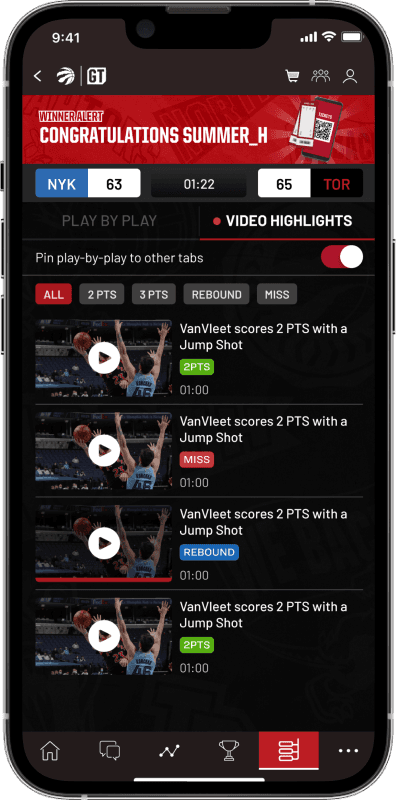
When league rules blocked live video, I proposed attaching highlight clips to the Play-by-Play feed so fans could see key moments immediately after each play. To avoid spoilers caused by NBA data arriving ahead of TV broadcasts, I worked with the squad to introduce an artificial delay that kept the experience aligned with live viewing.
Engagement Loop
The Cheer feature let users tap to “cheer” during key moments — one Leafs game saw 52K clicks from 733 visitors. Trivia reached 55–60% participation among active users. Together, these features created a stronger engagement loop: users came for chat, stayed for trivia, and discovered highlights. This contributed to increased dwell time and return visits.

What I Learned
This project taught me that speed of learning beats speed of shipping. The features that succeeded weren't the most polished — they were the most validated.
Co-Creation Over Assumption
Positive feedback on Play-by-Play wasn’t luck. Users helped shape it from survey to wireframe to testing. When fans feel ownership, they become advocates. Design research isn’t a phase, it’s a continuous conversation.
Systems Enable Scale
The component library, the UX Metrics dashboard, the validation process — these systems outlasted any single feature. When the platform was licensed to other NBA teams, the modular approach made adaptation straightforward. Good design infrastructure compounds.
